---
title: "Uptime badge"
description: "Embed a monitor's live uptime badge in a README, a forum post, or your own site."
doc_version: "1"
last_updated: "2026-11-19"
---
## What it does
Every public [status page](/docs/guides/free-status-page/) has an SVG badge at `/badge.svg` under the page's URL. The badge reads **uptime** on the left and the monitor's 30-day uptime and current status on the right, for example `99.97% · up`. The right half is green while the monitor is up, red while it's down, amber while it's flapping, and gray while it's paused or its status is unknown. A monitor with no uptime data yet reads `no data` in place of the percentage.
The page's embed snippets wrap the badge in a link back to the status page, so a click on the badge opens the full page. The badge renders anywhere an image does: a README, a forum signature, or your own site's footer.
The badge belongs to the status page. It exists only while the monitor's status page is on, and its URL carries the same token as the page URL.
## Set it up in the app
:::caution
The badge URL contains the status page's token, so embedding the badge on a public site shares the page URL with that site, its visitors, any image proxy in front of it, and crawlers. Treat it the same way you'd treat sharing the page link itself. The [Status page](/docs/guides/free-status-page/#set-it-up-in-the-app) guide lists what the page publishes.
:::
1. Turn on the monitor's status page, as described in [Status page](/docs/guides/free-status-page/#set-it-up-in-the-app).
2. On the monitor's detail page, in the **Status page** section, click **Open**.
3. On the public page, scroll to **Embed this badge**. It previews the badge on a light and a dark background.
4. Click **Copy** next to the **Markdown**, **HTML**, or **BBCode** snippet, and paste the snippet where you want the badge to show.
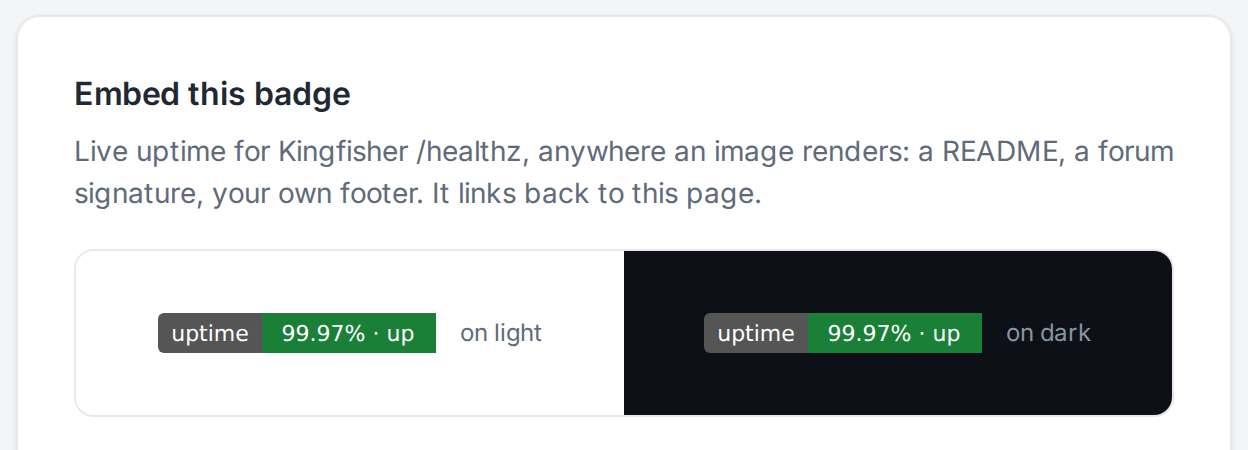
The page omits the BBCode snippet when the page URL can't be represented safely in that grammar.
## Do the same through the API or MCP
The badge URL is the status page URL followed by `/badge.svg`. Read the page URL from the API:
```bash
curl https://api.monitive.com/api/v1/monitors/1287/status-page \
-H "Authorization: Bearer $MONITIVE_API_KEY"
```
```json
{"enabled": true, "url": "https://status.monitive.com/sp_0123456789abcdef0123456789abcdef"}
```
If `url` is `null`, the page is off. Turn it on first, as described in [Status page](/docs/guides/free-status-page/#do-the-same-through-the-api-or-mcp).
Assign the URL to a shell variable instead of pasting it straight into a command, and replace the value with your own page's URL. The badge route takes no `Authorization` header and returns `image/svg+xml`:
```bash
PAGE_URL='https://status.monitive.com/sp_0123456789abcdef0123456789abcdef'
curl "$PAGE_URL/badge.svg"
```
The page's **Embed this badge** section renders these two snippets for that URL:
```html
 ```
```markdown
[![Uptime status]()]()
```
There's no MCP tool for the status page switch, and the badge needs none: once the page is on, the badge URL is public.
## Plan limits
- One badge per monitor, tied to its single status page. The badge's label, colors, and text aren't configurable.
- The percentage covers the same trailing 30-day window as the status page and the uptime API.
- The badge comes from the same cached snapshot as the page, so it can be up to about 70 seconds old at the origin. See the status page's [Plan limits](/docs/guides/free-status-page/#plan-limits) for how the cache works. An embedding site or an image proxy can hold the badge longer.
- Turning the status page off revokes the badge along with the page. The old badge URL can keep answering for about 70 seconds at the origin, and longer where an image proxy cached it.
- Turning the status page on or off requires the account owner role.
## Troubleshooting
**The badge shows as a broken image, or its URL returns `404`.** The status page is off, the monitor was deleted, the account is suspended, or the token is malformed. A paused monitor does not cause this: the badge keeps serving with a gray `paused` status. Like the page, the badge route is GET-only, so a `curl -I` probe also returns `404`.
**The badge broke after I turned the page off and back on.** Turning the page back on mints a different token, so the old badge URL is gone. Copy the snippet again from the page.
**The badge and the page briefly disagree.** All formats (page, feeds, JSON, and badge) carry the same data, and the same `Cache-Control` policy, only while they're served from the same cached snapshot. `Age` won't confirm that: it's calculated per response from when each request reached the cache, so it can differ across formats even when they share a snapshot, and an intermediary cache can change it further. A request right before that snapshot expires and another right after can land on different snapshots with no proxy involved.
**The badge in a GitHub README lags the page.** GitHub serves README images through its own image proxy, camo, which can hold the badge longer than the status page's cache does. Other sites that proxy or cache images behave the same way. To see the current number, open the status page.
**`503` with a `Retry-After: 5` header.** A page build hit its time limit. Retry after the advertised delay. Don't turn the page off and back on to fix it: that mints a different URL and breaks every embedded badge.